Standardizing User Activation: How We Built a Shared Data Layer at Karrot

핵심요약
Karrot built a shared data layer, the Activation Layer, by adopting the User Activation framework to overcome the limitations of Active User metrics. The Activation Layer addresses reliability, cost, and productivity issues, utilizing FirstLast, Activation, and Activation Status models to analyze user activity states and flows.
Standardizing User Activation: Building a Shared Data Layer at Karrot
1. Background and Goals
- Limitation of Active User Metrics: Only shows 'what happened', not 'why it happened'.
- Need for User Activation: Analyzing user activity through States and State Transitions for deeper insights.
- Goal of Shared Activation Layer: Ensure data reliability, operational stability, and increase reusability.
2. Activation Layer Structure and Design
- Layered Architecture: Composed of Base → Fact → Activation layers.
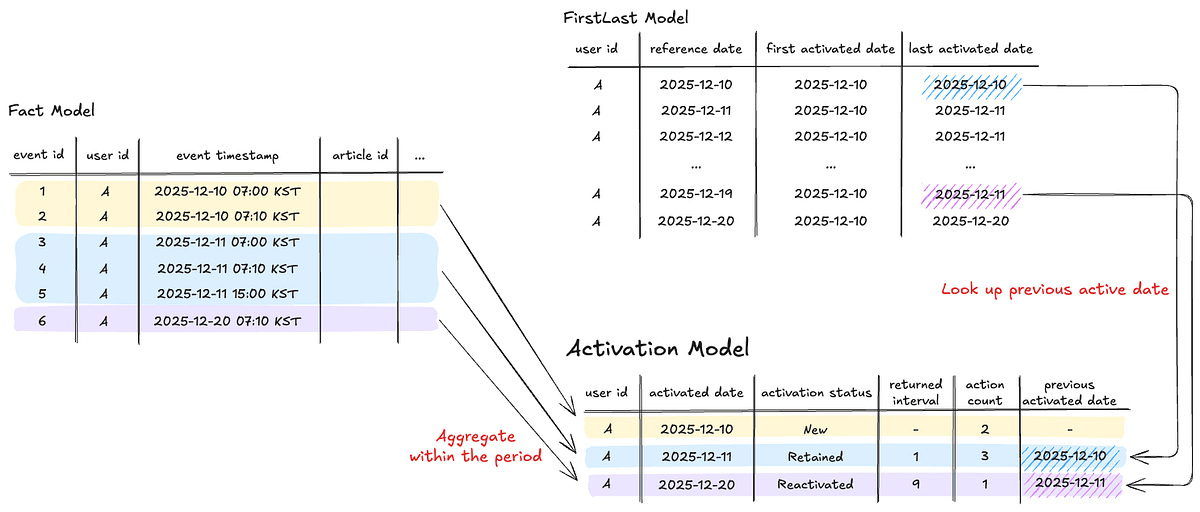
- Core Models: Operates a set of three models – FirstLast, Activation, and Activation Status – based on a Fact model.
- Key Challenges Addressed:
- Reliability: Clearly defining reference actions in Fact models to eliminate ambiguity.
- Cost: Implementing a daily snapshot approach in the
FirstLastmodel to minimize backfill and daily calculation costs. - Productivity: Enabling the creation of new Activation models without writing SQL by leveraging DBT Macros.
3. Detailed Model Functions
- FirstLast Model: Stores daily snapshots of each user's first/last action timestamps (cost optimization).
- Activation Model: Calculates New/Retained/Reactivated states and return intervals based on Fact data (decomposes Active User components).
- Activation Status Model: Provides inactivity duration, consecutive active days, and transition segments, including inactive periods (refines user flow).
4. Use Cases
- AU Dashboard: Identifies causes through contribution by activity state and Transition Segment analysis.
- Marketing Targeting: Analyzes CRM actions and performance using criteria like inactivity duration.
- Core Action Tracking: Defines core actions per service and supports strategic decisions from the perspective of user flow changes.